Tuesday, March 3, 2020

Politically correct fairy tales


UPDATE:  Do your best to finish your rough drafts by Friday.  Turn in your rough draft to:
Turnitin.com  (Use this link)

**Remember, I am offering an online video/ phone chat via Google Hangouts on Thursday, 4/2 @ 1PM

Today, we will be reviewing how to use online meetings, and I can answer any questions on the project.  We will be using this link in the future for class.

If you don't have internet, and do have unlimited calling, use the phone number and call in.

The meeting link/ phone number is in your school email.  I sent you a group message.

If you can't join and have questions, please feel free to drop me an email @ tchristian@berwicksd.org.


ASSIGNMENT:
As children, we all loved fairy tales.  Stories of princesses, wolves, eggs, bears, etc, have amused generations since the beginning of time.  Sometimes the hero wins, others....not so much.  However, each tale usually encompasses an important life lesson.

Looking at these stories, one element is vividly clear.....they are politically incorrect. 

Let's face it, in most cases/ stories....someone should have known better!  In our day and age, technology rules, and society is just different.  People are independent, and can think for themselves.  Parents are more aware, and technology serves as the foundation of communication.  (FYI, Little Red's people needed to pay attention!    Damsels in distress, move over....in today's society, there are strong, independent individuals!!)

Today, we are going to write and present politically correct fairy tales.

1. Make a list of 10 societal changes.  (Think of your tales, and create a list of 10 areas of change.)
-What are 10 elements that should be featured in a modern-day fairy tale.

2, Group discussion - changes, key concepts that should be included/ featured, topics for the tales, etc

3. With a partner, (you may work alone), we are going to create amusing, up-to-date, politically correct fairy tales.

*If you have a partner, you will be presenting in a tag-team manner.  Your grade will reflect the overall presentation.  So, find someone who can play the part.  (Ex: change voices, express emotions, and transition with ease)

Assessment:  Rubric
Peer evaluation

Monday, February 10, 2020

Tag Speeches

Extemporaneous Speeches.....no planning required.....pressure to speak without formal planning

1 Impromptu

2. Pick a topic - You will get five minutes and a notecard
3. Speech time - Minimum 3:00 minutes
4. First person starts:  1:30-1:45 - you tag in another person


First person requirement:

A. Intro.
(Make sure it's an interesting/ motivating intro) (10 points)
B. Background  (10 Points)
C. Anecdote (Personal connection fully expressed (10 points)

Tag

Second Person:
D. Transition yourself in using a key point of information presented by the person ahead of you ( 10 points)

E. Expand the topic in your opinion (10 points)

F.  Include an anecdote  (Personal story fully explained: (10 points

G. Conclusion:  Complete conclusion (10 points).

Monday, January 6, 2020

Mid Term- I search the word

Directions

I SEARCH- THE WORD

GOAL: Students will explore and utilize various forms of research

1. Choose an intangible word. This word may be of your own choosing with the permission of the teacher, or you may choose from the list that is provided. Each student will have a different word. You will need to sign up for the word you choose.
2. You need to research the word in all of the sources listed below. Make certain you write down the REFERENCE INFORMATION for each source: the title of the book or magazine, author or editor of that book or magazine, the year and place of publication, and the page number of the source. Use the Write for College MLA format section. Mrs. Henrie and I are also available for help.
a. Look you word up in an unabridged dictionary. Copy the word’s etymology and its first definition. TYPE/ copy or hand copy the remaining definitions. If the dictionary does not have the etymology listed, you must use an etymology dictionary. Make note of its previous meanings. This may be in story form showing the growth of the word.
b. Look up you word in a thesaurus. Copy the first group of synonyms and all the bold faced words.
c. Look up in a concordance to the Bible. Find a verse that contains your word; copy it. Explain it. Use the concordance to cross reference a Bible.
d. Look up you word in the Concordance to Shakespeare. Find a passage that contains you word, then, look up the passage in any of the complete works of William Shakespeare and copy the whole speech which contains the word. Include the speaker’s name, act, scene, and line numbers in your reference information. You will have to explain this to your reader.
e. Look up your word in Granger’s Index to Poetry. Use one of the poetry anthologies and copy a poem that contains your word. Make note of the title, author, and page. You will have to explain this to your reader.
f. Look up your word on Power Library—ex. GALE—Student Research Center. Find an article which deals with you word. Locate the article, read it, and summarize the article. SOURCES ON POWERLIBRARY
g. Interview your grandparents and/or your parents plus one other person (three people from different genterations...one must be your generation). Write down what they think your word means. [You will need to cite three interviews including the time.]
h. Look up your word in a book of quotations. Copy a quotation which contains your word and the quotation’s identifying information. Explain what the quotation means.
I. Current movie/ tv reference.  Find your word used directly in a movie/ tv show.  Reference and explain how it is used.

J. Look up your word in Google....once the word comes up, click the link under the def:  more translations.
-This will give you a great overview of the word and show you how it increased or decreased in usage over time.

1/7:  TUESDAY: SELECT WORD AND BEGIN BASIC RESEARCH
1/8:  WEDNESDAY: Library  PORTION
1/9 - 1/10 THURSDAY AND FRIDAY: LIBRARY 
1/13-1/15:  TURN IN NOTECARDS, ORGANIZE RESEARCH, AND CREATE YOUR OUTLINES
1/16- 1/17: PRACTICE
1/21-1/24: WEDNESDAY- FRIDAY - PRESENTATIONS

REQUIREMENTS: 
1. YOUR PRESENTATION WILL BE A MINIMAL OF 5 MINUTES
2. YOU WILL PRESENT YOUR WORD AND ALL OF THE HISTORY AND STORIES BEHIND IT. 
3. YOU MAY USE 2 NOTE CARDS (They may only contain points.  Full sentences and paragraphs will result in a 0)
4. YOU MAY PUT POWERPOINT SLIDES ON THE BOARD
5. MUST FOLLOW THE 6X6 RULE.  ANY PRESENTATION WILL RECEIVE A 0 IF YOU DON'T FOLLOW THIS RULE.
6. NO VIDEO CLIPS LONGER THAN 30 SECONDS
7. YOUR RESEARCH MUST BE TURNED IN TO NOODLE TOOLS
8 YOU MUST HAVE A CITATION AND NOTES FOR ALL OF THE FOLLOWING: 
A. UNABRIDGED DICTIONARY
B. ETYMOLOGY DICTIONARY
C. BIBLE
D. THESARUS
E. CONCORDANCE TO SHAKESPEARE
F. GRANGER'S INDEX TO POETRY
G-I.  THREE INTERVIEWS
J. BOOK OF QUOTES
K. MODERN MOVIE/ TV
L. ONE SOURCE YOU FIND AND RELATE TO

M. Google:  more definitions/ translations.  Check out the usage graph

SETUP:
1. INTRODUCTION:  MUST CAPTIVATE THE AUDIENCE AND PROVIDE A STRONG FOUNDATION FOR YOUR SPEECH
2. MUST INCLUDE DETAILS AND STORIES
3. IF YOU MAKE A STATEMENT OR STATE A FACT, YOU MUST EXPLAIN IT
4. PRESENT ALL ORIGINS OF YOUR WORD AND CONNECT WITH TRANSITIONS BETWEEN YOUR VARIOUS ORIGINS
5. MUST INCLUDE YOUR CONNECTION TO THE WORD/ PERSONALIZE IT
6. CONCLUSION/ SUMMARY CONCLUSION

GRADING:
5 MIN WILL QUALIFY FOR FULL CREDIT
4 MIN WILL QUALIFY FOR A GRADE OF:  B
3 MIN WILL QUALIFY FOR A GRADE OF: C
2. MIN WILL QUALIFY FOR A GRADE OF : D
UNDER 2 MIN WILL FAIL

*JUST BECAUSE YOU REACH YOUR TIME, DOES NOT GUARANTEE THE GRADES LISTED ABOVE.  YOU MUST MEET ALL ELEMENTS LISTED UNDER THE "REQUIREMENTS" SECTION


INTANGIBLE WORD SUGGESTION LIST:


Assessment:  Rubric
Peer evaluation

Monday, December 16, 2019

Nonverbal Communication

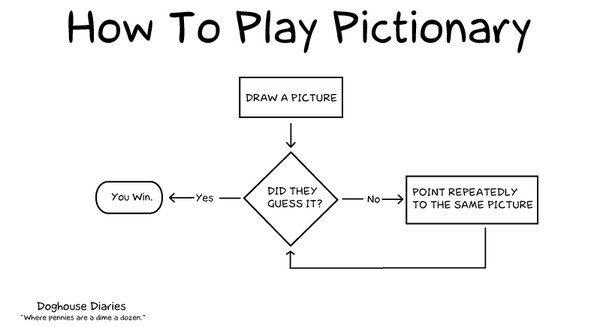
how-to-play-pictionary
Appoint one person to write down the items, phrases, etc. that players must draw. This person will also serve as the timer and as a referee, making sure players follow the rules and resolving any disputes. Divide the players into teams, with at least two people on each team. Let the teams choose a name and then provide each team with plenty of paper and a pencil or pen for each player. After deciding which team goes first, have a member of that team draw a slip of paper from a box, bag, or basket with a word or phrase on it. When the referee says, “Go!” the designated team player draws the word or phrase and their team guesses the meaning of what is drawn. The time limit is one minute. If their team correctly guesses the word, they receive one point. The other team repeats this process.

Rules: seconds to look at the clue; 1 minute
No letters, No numbers, No speaking, No answering verbal questions unless it pertains to the drawing. And then you have to draw the answers--again no words, numbers, letters
No pointing
You may use slashes to indicate how many words and syllables in each word
An X may be used for location 
Draw the ear for Sounds Link
Draw a check if they answer correct a minus if they are wrong.  No pointing or nodding.
If your team doesn't get the picture, the next team will have 15 seconds to guess the answer for double points.

Wednesday, December 11, 2019

Nonverbal communication

Today we are going to use our acting abilities to demonstrate body language and nonverbal communication.
Team scores:
1. First place 10 points   
2. Second place 9 points

Charade Rules
Three people to a team
No phrase less than 7 words
Objective of the game:
Charades is a game of pantomimes: you have to "act out" a phrase without speaking, your team members try to guess what the phrase is. Your team members must guess the phrase as quickly as possible before time runs out.
What you need:
·         Charades Cards or pieces of paper with written phrases on
·         Timer
·         Container for each of the teams to place their cards in
·         Pen & paper to keep score

2 Minutes to state category and act out word
Categories:  Movies, Music, song, etc
Next, tell how many words using your hand
Finally, act our your topic

MAIN RULES PLAYING CHARADES
·         Two teams divided into equal players
·         A time and score keeper is selected, usually a person not taking part or else one person from each team can take turns.
·         No words. No pointing at objects in a room. No lip movements, No soounds
·         Only "acting out" words or pantomiming similar sounding words.
·         A charade card with a phrase of Team 1 is revealed to one person (the actor) of team 2 and kept secret from the rest of team 2, team 2 must guess their actor's act.
·         The team demonstrating the act choose their actor, no actor may act more than once until all team members had a chance to be the actor.
·         The actor has limited time (2 minutes) to act out the phrase to his own team.
·         Decide on a time frame within which actors must complete their tasks before play commence, this will stay the same throughout the game.
·         The actor can make any gestures to act out the word.
·         The teams alternate until each team member had a chance to be the actor.
·         No clapping or whistling, no sound.
·         The guessers may ask the actor questions. To which the actor may nod.
Most importantly: HAVE FUN WITH THE RULES WHEN YOU ARE PLAYING CHARADES!

Monday, December 9, 2019

Impromptu

You will be given a topic
You will have 5 minutes to prepare your thoughts
You may use one side of a notecard
You must speak for 2 minutes.

We will use a typical rubric

Tuesday, December 3, 2019

Finding and discussing key points

How to find the main points in an article. Look at the headline or title. It often broadly summarizes the main topic of a news or magazine article. Carefully read through the article. Then go back to the beginning of the article and identify sentences that give some of the most important pieces of information in the article.

1.Pick up a copy of the Student Times, on my desk.
Read the front page article.  It's continued on page 3.
Read the entire article.

2. Write down three key sentences that illustrate key points within the article.
3. Under each key point, write down 1-2 talking points to be discussed in class.
4. Turn in your work by the end of the period.